Our History
Background
The waiting list for organ transplants continues to grow rapidly, with over 92,000 transplant candidates currently on the list. Of these, over 67,000 are waiting for a kidney transplant and over 25,000 are waiting for other organ transplants-liver, lung, heart, pancreas, or lung. While the list continues to grow, the number of deceased donors has not changed significantly in the last ten years.
Living donation, however, has grown rapidly due to advances in the field of transplantation. In 2001, the number of living donors in the U.S. (6,548) surpassed the number of deceased donors (6,082) for the first time.
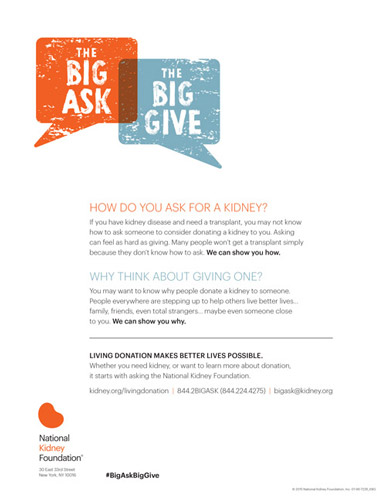
As living donation became more common, thousands of individuals contacted the National Kidney Foundation in search of information and support. Whether they had already donated, were undergoing testing to become donors, were family members or friends of potential or actual donors or were simply researching the process, people expressed a common want to connect with other donors and medical professionals who could understand their concerns.
National Kidney Foundation's Living Donation Initiatives
1999: www.livingdonors.org
In late 1999, NKF launched a new resource and online gathering place on living donation at www.livingdonors.org. The website, incorporating medical information with monthly Chats, an email discussion group, pen pals and a message board, brought together donors, potential donors, family members and transplant professionals in an open, educational forum. In its first month, www.livingdonors.org welcomed nearly 2,000 visitors, pushing the voice of living donation to the forefront of patient education and support.
2000: Consensus Conference on Living Donation
On June 1 and 2, 2000, more than 100 representatives of the transplant community, including physicians, nurses, ethicists, psychologists, lawyers, scientists, social workers, transplant recipients and living donors met in Kansas City, MO under the sponsorship of the National Kidney Foundation and the American Societies of Transplantation, Transplant Surgeons and Nephrology to evaluate current practices of living donor transplantation of the kidney, pancreas, liver, intestine and lung.
The goal of the Conference was to develop recommended practice guidelines for all those concerned about the well-being of the live organ donor. These guidelines were published in the December 13, 2000 issue of the Journal of the American Medical Association.
2001: Consensus Conference on Non-Directed Donation
Following the success of unrelated living donations from spouses, friends and coworkers, transplant professionals began to explore non-directed donation, or donation from a volunteer to an anonymous recipient.
On May 31, 2001, members of the transplant community met in Boston, MA to develop ethical guidelines for health care professionals involved in the care of potential non-directed donors. Sponsored by National Kidney Foundation, the Conference included representation from the American Society of Transplantation, American Society of Transplant Surgeons, American Society of Nephrology, United Resource Networks, United Network for Organ Sharing, Association of Organ Procurement Organizations, National Institutes of Health and the Division of Transplantation of the Health Resources and Services Administration.
Conference participants developed a report entitled "The Nondirected Live-Kidney Donor: Ethical Considerations and Practice Guidelines," published in the August 27, 2002 issue of Transplantation.
2002: Living Donor Recognition Event
National Kidney Foundation hosted its first Living Donor Recognition Event during the 2002 U.S. Transplant Games. Living donors were honored by NBA star Sean Elliott, who received a kidney from his brother, Noel. Transplant surgeon Dr. Francis Delmonico commended living donors for their courage and generosity and gave a brief history of living donation. Living donors and recipients talked about what their experience meant to them and the event concluded with a rousing rendition of "Love Can Move Mountains," performed by transplant recipient Kim Montalvo. NKF also unveiled a new lapel pin honoring living donors and recipients.
2002: New Publications
NKF developed new resources to meet the needs of potential donors, including a brochure for potential non-directed donors and an informative booklet, Living Donors: Answering Your Questions About Living Donation.
Public Policy Initiatives
The National Kidney Foundation wants to ensure that more Americans are afforded the opportunity to serve as living organ donors by helping to alleviate any undue financial burden they may incur as a result of their decision to donate. The NKF spearheaded legislative efforts to provide grants to transplant centers, organ procurement organizations, and other entities. The grants would be used to offset unreimbursed, non-medical expenses, including costs for travel and subsistence for living organ donors. This provision was included in H.R., 3926, the Organ Donation and Recovery Improvement Act, signed by President Bush on April 5, 2004.
On April 14, 2005, transplant surgeon Dr. Ginny Bumgardner and pediatric resident Dr. Trent Tipple presented testimony before the U.S. House of Representatives Appropriations Subcommittee on Labor, Health and Human Services, Education, and Related Agencies today to request $25 million in funding for the Organ Donation and Recovery Improvement Act of 2004.
Bumgardner, an Associate Professor of Surgery at the Ohio State University and Tipple, a neonatology fellow who is also a kidney transplant recipient and member of the National Kidney Foundation's transAction Council Executive Committee, testified on behalf of a coalition of 12 organizations representing the Transplant Roundtable.
The testimony focused on the ways this legislation, enacted in 2004 but not yet funded, could expand the pool of donor organs available for transplant in the United States. Funds would be allocated for the reimbursement of travel expenses for low income living donors, for hospital-based "organ coordinators," demonstration projects to increaseorgan donation and for studies by the Agency for Healthcare Research and Quality that would develop new methods for organ recovery, preservation and transportation.
The Transplant Roundtable includes the American Association for the Study of Liver Diseases, the American Association of Kidney Patients, the American Association of Tissue Banks, the American Liver Foundation, the American Society of Pediatric Nephrology, the American Society of Transplantation, the Association of Organ Procurement Organizations, the Eye Bank Association of America, the National Kidney Foundation, the North American Transplant Coordinators Organization and the United Network for Organ Sharing.
Still Growing
National Kidney Foundation continues to support living donation through its participation in consensus conferences, resource development, recognition events and online programs. Presently,
- More than 700 living donors are members of the National Kidney Foundation
- 150 current and potential donors and medical professionals communicate with one another through the email discussion group
- NKF staff respond to hundreds of calls and emails about living donation every week
- Thousands of people visit www.livingdonors.org each month seeking information and support