September 18, 2026
Article By: Miriam Godwin, NKF Vice President of Health Policy
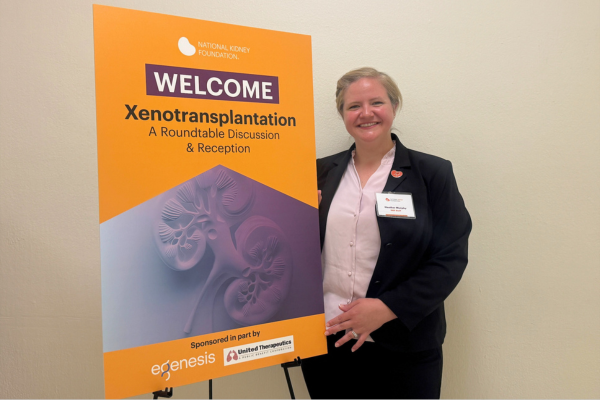
Heather Murphy, NKF's Medical Project Director of Strategic Partnerships
On Tuesday, September 15, 2026, the National Kidney Foundation (NKF) gathered federal health officials, leading clinicians, bioethicists, and a transplant recipient and member of NKF’s Kidney Advocacy Committee (KAC) on Capitol Hill to discuss one of the most promising frontiers in transplant medicine—xenotransplantation.
The discussion focused on the science, clinical and ethical considerations, policy questions, and patient needs surrounding kidney xenotransplantation as researchers work toward expanding the supply of organs available for transplantation.
Table of Contents
Key Takeaways
Key Takeaways
Clinical, ethical, and policy questions remain as xenotransplantation research moves forward.
Patient perspectives are essential to conversations about safety, access, cost, equity, and long-term outcomes.
NKF remains committed to helping patients and families understand and stay informed as xenotransplantation research continues to develop.
NKF’s Roundtable Discussion on Capitol Hill
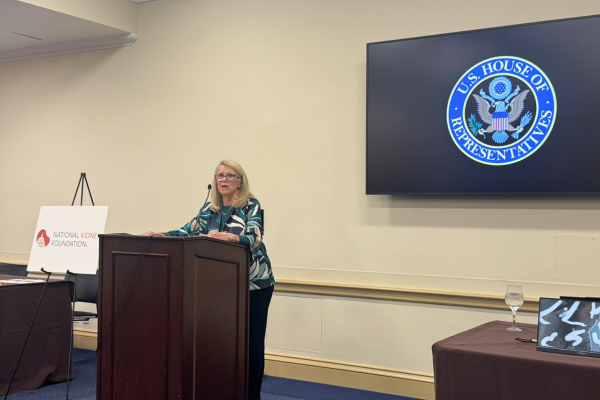
Congressional Kidney Caucus Chair Rep. Carol Miller
At the heart of the panel were:
- Dr. Ben Hippen, Chief Medical Officer, Dialysis Services Industry, Fresenius Medical Care (FME)
- Dr. Olivia Kates, Associate Professor, Transplant Oncology Infectious Diseases, Berman Institute of Bioethics, Johns Hopkins University
- William Johnson, kidney transplant recipient and member of the NKF Kidney Advocacy Committee (KAC)
The day concluded with an evening reception and remarks by Congressional Kidney Caucus Chair Rep. Carol Miller.
Both events were generously sponsored by United Therapeutics and eGenesis, who are at the forefront of xenotransplantation research and development and also presented on their work at the evening reception.
Discussing the Policy and Science
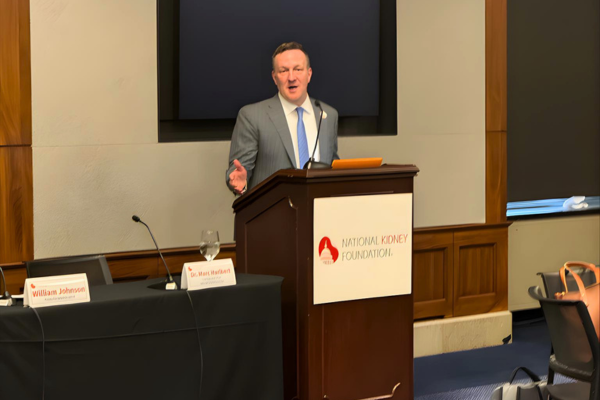
NKF Chief Executive Officer Dr. Marc Hurlbert speaking at NKF Capitol Hill Roundtable on Xenotransplantation
NKF Chief Executive Officer Dr. Marc Hurlbert opened the roundtable, setting the stage for a conversation about how xenotransplantation could help close the gap between the nearly 90,000 Americans waiting for a kidney transplant and the limited supply of donor organs available today.
Dr. Carisa Schweitzer Masek, Counselor in the Immediate Office of the Secretary at the U.S. Department of Health and Human Services, followed with remarks about:
- Judging innovation for what it means for patients, rather than checking a box that an exciting advancement moved forward
- The Administration’s commitment to confronting chronic disease while advancing biomedical innovation, grounded in bold science
- Giving more patients the chance to live longer and healthier lives with safe, effective choices
The discussion also highlighted clinical and ethical considerations for kidney xenotransplantation, including safety, long-term outcomes, infection risk, access, cost, and equity.
Dr. Kates and Dr. Hippen then both offered clinical and ethical perspectives on kidney xenotransplantation.
Rep. Carol Miller, Congressional Kidney Caucus Chair, spoke to attendees about the importance of federal policies that raise awareness of kidney disease and give people better options for kidney failure treatment.
Bringing the Patient Perspective to Xenotransplantation
Heather Murphy, NKF's Medical Project Director, provided an update on NKF’s patient-focused efforts related to xenotransplantation, including:
- Externally-Led Patient-Focused Drug Development report on xenotransplantation that led to the first xenotransplant clinical trials
- Patient-facing question-and-answer portal
- Podcast featuring some of the first recipients of a xenotransplanted kidney
“As the field moves forward, patients want to be informed and involved. They want answers about safety, longevity, access, cost, equity, and what xenotransplantation will ultimately mean for them. That gives us all an important responsibility,” she said. “Our job is not only to advance the science, but to make sure the patient voice advances with it.”
What Patients Want to Know About Xenotransplantation
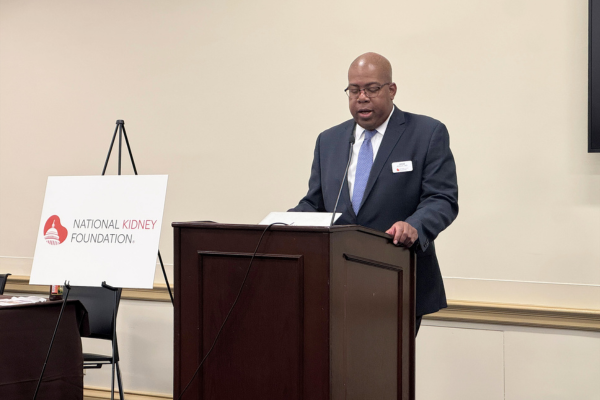
William Johnson emphasized the need for better education to help patients understand their options for kidney failure treatment, including xenotransplantation.
He also spoke about the need for access, sharing a real-life example from his own life: he found that many patients don’t know they can travel to other centers to expand their transplant options.
This will be especially important for xenotransplantation as it expands outside the clinical trial setting. Xenotransplantation requires specialized care that not all transplant centers are currently equipped to deliver.
Evening Reception and Innovation Showcase
The day's programming continued that evening with a happy hour and innovation showcase, where attendees had the opportunity to connect with the researchers and companies driving xenotransplantation forward.
United Therapeutics and eGenesis presented on their respective work advancing xenotransplantation research, offering attendees a closer look at the transformation of science into clinical reality.
Rep. Carol Miller, Congressional Kidney Caucus Chair, spoke to attendees about the importance of federal policies that raise awareness of kidney disease and give people better options for treatment.
Why Kidney Xenotransplantation Matters
Kidney disease affects more than 35 million Americans, and for those who progress to kidney failure, transplantation remains the best treatment option for most individuals with kidney failure. However, the shortage of donor kidneys means thousands of patients die each year while waiting. Xenotransplantation represents one of the most significant potential breakthroughs in decades for closing that gap.
Ready to help NKF push for policies that move innovation forward? Become a Voices for Kidney Health advocate today.
NKF extends its thanks to Rep. Carol Miller and Congressional Kidney Caucus Co-Chair Rep. Suzan DelBene for their continued leadership and support in bringing this important conversation.