Last updated: July 24, 2026
Medically reviewed by: NKF Patient Education Team
Hemodialysis pronounced hee-moh-dye-AL-uh-sis, is a life-saving treatment for kidney failure. It uses a machine and a filter to clean your blood when your kidneys can no longer do enough of this work.
Table of Contents
- About hemodialysis
- When hemodialysis is used
- How hemodialysis works
- Your dialysis access
- Types of hemodialysis
- How your dialysis team checks if treatment is working
- Side effects/symptoms of dialysis and safety
- Daily life with hemodialysis
- Questions to ask your dialysis care team
- Kidney health information, support, and professional resources
About hemodialysis
Hemodialysis is a life-saving treatment for kidney failure. It removes waste, extra fluid, and extra minerals from your blood when your kidneys can no longer do enough of this work.
Hemodialysis can help you feel better and live longer. It is not a cure for kidney failure. It replaces only part of what healthy kidneys do. You may still need medicines, to make changes to what you eat and drink, and regular visits with your dialysis care team.
Hemodialysis cleans your blood, but it does not do everything healthy kidneys do. How long your hemodialysis treatment is prescribed for, medicines, eating plan, and fluid management all work together.
When hemodialysis is used
Hemodialysis may be used in two main situations:
- Acute kidney injury, also called AKI: This is a sudden kidney problem that happens over hours or days. Some people need dialysis for a short time while their kidneys recover.
- Kidney failure also known as end stage kidney disease (ESKD): This is the last stage of chronic kidney disease. It often means your kidneys are working at about 10% to 15% of normal, or a blood test called eGFR is less than 15. Some people start dialysis because of symptoms or unsafe blood test results, even if their number is higher or lower.
Your doctor may recommend hemodialysis if waste, fluid, potassium, or acid builds up in your body and cannot be managed safely with medicines, nutrition changes, or other treatments.
How hemodialysis works
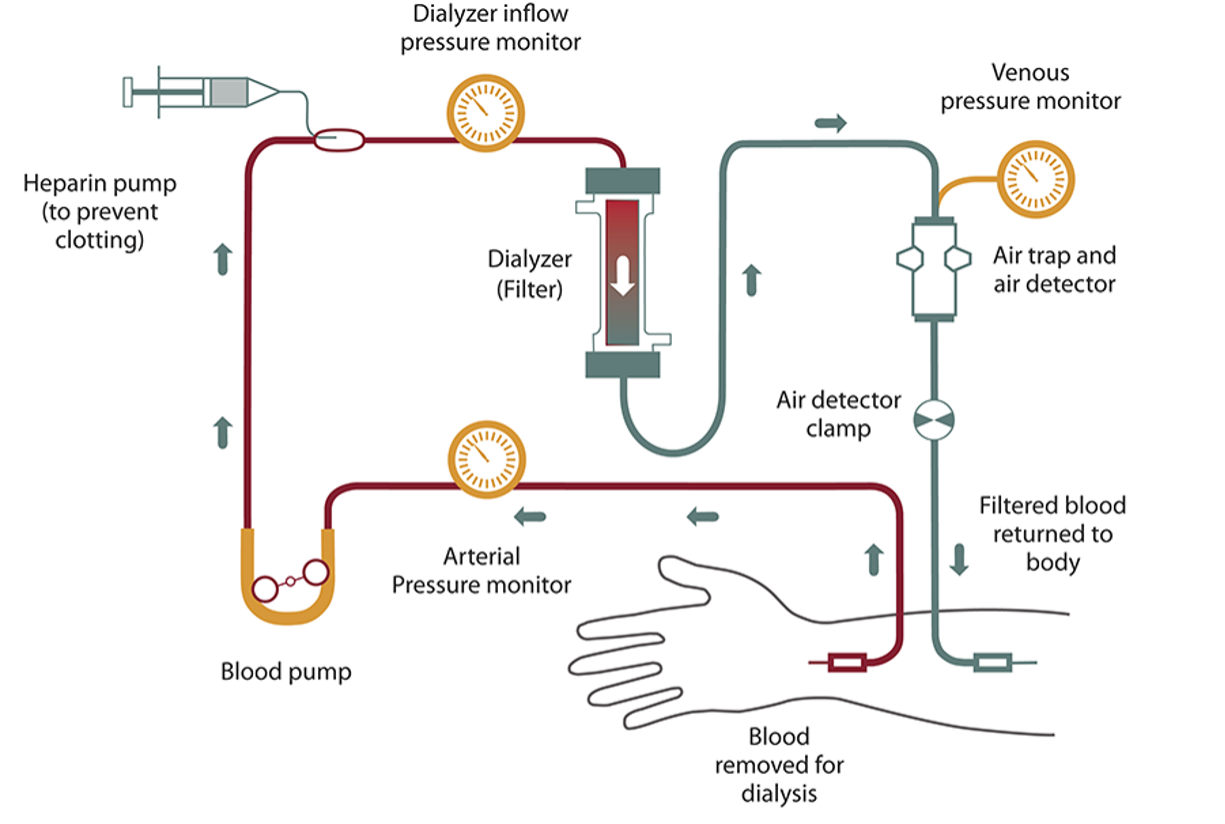
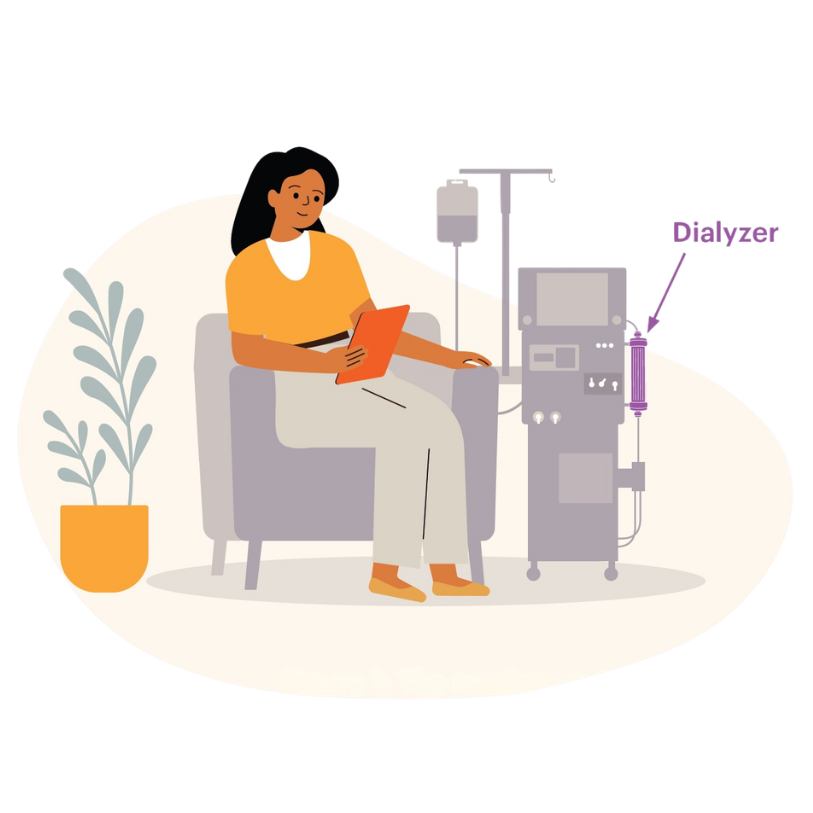
During hemodialysis, blood moves from your body through soft tubes to a dialysis machine. The machine sends your blood through a filter called a dialyzer pronounced DYE-uh-lye-zer. The dialyzer is sometimes called an artificial kidney.
Inside the dialyzer, your blood flows on one side of a very thin filter. Dialysis fluid flows on the other side. Waste and extra minerals move out of your blood and into the dialysis fluid. Extra fluid can also be removed. Cleaned blood then goes back to your body.
Different types of waste dialysis removes
Dialysis removes waste from your blood. Some waste products are small and easier to remove. Others are larger and may be harder to remove.
- Small waste products: Two examples are urea and creatinine. Urea comes from the protein your body uses. Creatinine comes from normal muscle use. Your care team may check these with blood tests to see how well dialysis is cleaning your blood.
- Larger waste products: Some waste products are larger. These are sometimes called middle molecules. Some newer dialysis filters and treatments are designed to remove more of these larger waste products.
Some newer dialysis treatments are designed to remove a wider range of waste products. The right treatment depends on your health, your access, and what is available at your dialysis center.
How dialysis removes waste and fluid
Dialysis removes waste and extra fluid in a few ways:
- Waste removal: Waste moves out of your blood and into dialysis fluid.
- Extra fluid removal: Dialysis can remove extra fluid from your body. This can help with swelling, blood pressure, and breathing.
Removing too much fluid too quickly can make you feel sick. It may cause cramps, dizziness, nausea, headache, or low blood pressure. Tell your dialysis team how you feel during and after each treatment.
Your dialysis access
To do hemodialysis, your care team needs a safe way to reach your blood. This is called vascular access, or dialysis access. The access is often placed by a minor surgery.
Three access types
Fistula: A connection made between an artery and a vein, usually in your arm. This is often the preferred access when it can be used.
Graft: A soft tube placed under the skin to connect an artery and a vein, usually in your arm.
Catheter: A tube placed into a large vein, often in the neck, chest, or groin. This may be used when dialysis needs to start quickly or while waiting for a fistula or graft to be ready.
Your access is your lifeline for hemodialysis. Tell your dialysis team right away if you have redness, warmth, swelling, pain, drainage, bleeding, fever, or a change in how your access feels or works.
Three words you may hear: diffusion, convection, and ultrafiltration
Your care team may use technical words to describe how dialysis works. Here is what they mean in plain language:
Diffusion: Waste moves out of the blood and into dialysis fluid. This is the main way standard hemodialysis removes many small waste products.
Ultrafiltration: Extra fluid that is removed from your body during dialysis. This helps with swelling, blood pressure, and breathing when too much fluid has built up.
Removing too much fluid too quickly can make you feel sick. It may cause cramps, dizziness, nausea, headache, or low blood pressure. Tell your care team how you feel during and after each treatment.
Types of hemodialysis
In-center hemodialysis
In-center hemodialysis is done at a dialysis center. Most people go 3 days each week. Each treatment often takes between 3 to 5 hours. Your doctor will prescribe how long your treatment needs to be. A nurse or technician helps set up the treatment and checks on you throughout your dialysis session.
Home hemodialysis
Home hemodialysis is done at home after training that is done by a dialysis nurse. Training may take around 6-10 weeks. Some people do home treatments more often, such as 4 to 6 days a week, but for shorter duration, around 2-3 hours. Some people do longer treatments while sleeping.
Home hemodialysis may offer more flexibility, but it also requires training, supplies, space at home, and a plan for safety. Some people need a care partner. Your dialysis team can help you decide if home treatment is right for you.
High-flux hemodialysis
High-flux hemodialysis uses a dialyzer with a filter that lets more water and some larger waste products pass through than older low-flux filters. Many dialysis centers use high-flux dialyzers.
Your doctor chooses your dialyzer based on your prescription, blood tests, access, body size, and treatment goals.
Expanded hemodialysis and medium cut-off dialyzers
Expanded hemodialysis, sometimes called HDx, uses a medium cut-off dialyzer. This type of filter is designed to remove a wider range of larger waste products, including some middle molecules. Middle molecules are medium-sized waste products that healthy kidneys usually remove, and during dialysis are more difficult to remove than smaller wastes. Removing these middle molecules can help people feel better.
Expanded hemodialysis may be done on standard hemodialysis machines, but it still requires the right dialyzer, the right prescription, and monitoring by your dialysis team. It may not be available in every dialysis center.
Hemodiafiltration and high-volume hemodiafiltration
Hemodiafiltration, also called HDF, combines regular hemodialysis with extra filtering that uses convection. This can help remove some larger waste products.
During HDF, the machine removes extra filtered fluid through the dialyzer. The machine then gives back clean replacement fluid. This replacement fluid must be sterile, which means it must be very clean and free from germs.
High-volume hemodiafiltration, also called HV-HDF, is a type of HDF that uses a higher amount of replacement fluid during each treatment. In research studies, high-volume HDF has been linked with better removal of some middle molecules and may improve some outcomes for some people.
HV-HDF is not available in every clinic. It may not be right for every person. Your doctor can explain whether it is available, whether your access can support it, and whether it fits your treatment goals.
HV-HDF does not make your dialysis treatment longer. Treatment time depends on your current prescription and care team. Ask your doctor whether HV-HDF is available and right for you.
How your dialysis team checks if treatment is working
Hemodialysis helps remove waste and extra fluid from your blood. It also helps keep safer levels of potassium, sodium, calcium, bicarbonate, and other minerals that your body needs.
Your team checks many things to see how well dialysis is working, including:
- How long does each treatment lasts
- How often you get treatment
- Whether you miss or shorten treatments
- How well does your access works
- How much blood moves through the dialyzer
- How much fluid needs to be removed
- Your blood pressure before, during, and after treatment
- Your lab results and symptoms
- Whether you still make urine (pee)
How your care team checks if dialysis is working well
You may hear your team talk about URR or Kt/V (sometimes said as K-T over V). These numbers help show whether dialysis is removing enough urea, which is one type of waste in the blood.
- URR: This stands for urea reduction ratio. It is the percent of urea removed during one treatment.
- Kt/V: This is another way to measure dialysis dose. It looks at treatment time, how well the dialyzer clears urea, and your body size.
For many people who do in-center hemodialysis 3 times a week, care teams often look for a URR of at least 65% or a Kt/V of at least 1.2. Your goal may be different based on your prescription and health needs.
These numbers matter, but they are not the whole picture. How you feel, your blood pressure, fluid gains, potassium, phosphorus, nutrition, access, and missed treatments also matter. Talk to your healthcare team about how you’ve been feeling during, after and between your treatments.
Side effects/symptoms of dialysis and safety
Some symptoms can happen during or after dialysis. Sometimes it is hard to know whether a symptom is from dialysis, kidney failure, medicines, food and fluid, or another health problem.
Common symptoms or problems can include:
- Low blood pressure
- Muscle cramps
- Headache
- Nausea
- Dizziness or weakness
- Feeling very tired after treatment
- Itching
- Bleeding or bruising near the access
- Infection or blockage in the access
Tell your dialysis team about symptoms during treatment, after treatment, or between treatments. They may be able to adjust your dialysis prescription which includes dry weight, fluid removal rate, dialysate temperature, medicines, dialysis time, or dialyzer.
When to call right away
Call your dialysis center, doctor, or emergency services right away if you have:
- Chest pain
- Trouble breathing
- Fainting or severe weakness
- Fever or chills
- Bleeding that will not stop
- Severe pain, swelling, redness, warmth, or drainage near your access
- A fistula or graft that stops buzzing or vibrating like usual
Safety with HDF and HV-HDF
HDF and HV-HDF need special safety steps because clean replacement fluid is given during treatment. The dialysis machine, water system, and replacement fluid must meet strict safety standards. Your team must also watch your blood pressure, access, and lab results.
Ask your dialysis team how they monitor water quality, machine safety, blood pressure, access function, and treatment tolerance if HDF or HV-HDF is being considered.
Daily life with hemodialysis
Food and fluid
Your eating plan will likely change when you start hemodialysis. You need enough protein and calories to stay nourished. You may also need to limit sodium, fluid, potassium, and phosphorus.
- Sodium is salt. Many people on dialysis are asked to limit sodium to about 2,000 mg a day, but your goal may be different. For scale, 2,300 mg of sodium is about the amount in 1 teaspoon of table salt. Most sodium comes from packaged, restaurant, and fast foods, not just the saltshaker.
- Fluid can build up between treatments. Extra fluid can cause swelling, high blood pressure, or trouble breathing. It can also make dialysis harder because more fluid has to be removed.
- Helpful fluid math: 1 kilogram of weight gain is about 1 liter of fluid. That is about 2.2 pounds, or a little more than 4 cups. If you gain 2 kilograms between treatments, that is about 2 liters of extra fluid, or a little more than 8 cups.
Your kidney dietitian at your dialysis center can help you plan meals and fluids based on your labs, weight changes, urine output, culture, budget, and food preferences.
Medicines, vitamins, and vaccines
Tell your dialysis team about everything you take. This includes prescription medicines, over-the-counter medicines, pain relievers, vitamins, herbs, and supplements. Some medicines may need a different dose or timing when you are on dialysis.
Ask your dialysis team which vaccines you need. People on dialysis have a higher risk of getting very sick from some infections.
Missed or shortened treatments
Try not to miss or shorten dialysis. Missing even one treatment can allow fluid, potassium, acid, and waste to build up. This can be dangerous.
Call your dialysis center as soon as possible if you cannot make a treatment. They may be able to help you reschedule or tell you what to do next.
Travel
Many people on hemodialysis travel. Planning ahead is important. Your dialysis center may help you find and schedule treatments near your destination. Try to start planning several weeks before your trip, or earlier for busy travel seasons.
Work and school
Many people on dialysis continue to work, go to school, care for family, and take part in daily activities. You may need a treatment schedule that works with your life. Ask your healthcare team about dialysis schedules that are available or if there is a waitlist for a particular dialysis treatment time. If your job includes heavy lifting or physical labor, ask your care team how to protect your access.
Insurance and costs
Medicare, Medicaid, private insurance, and other programs may help pay for dialysis. Coverage rules can be confusing. Ask your dialysis social worker, financial coordinator, or insurance plan to explain what is covered and what costs you may have.
Questions to ask your dialysis care team
Bring this list to your next visit or dialysis treatment. Choose the questions that matter most to you.
- What type of hemodialysis am I receiving now?
- How many hours of dialysis do I need each week?
- What are my Kt/V or URR results, and what do they mean for me?
- How much fluid am I gaining between treatments?
- What symptoms should I report during or after dialysis?
- What type of access do I have, and how should I protect it?
- Is high-flux dialysis, expanded hemodialysis, HDF, or HV-HDF available at this center?
- What food, fluid, potassium, phosphorus, protein, and sodium goals should I follow?
- Who should I call after hours if I feel sick or have a problem with my access?
- Can you help me plan dialysis if I travel?
- Can I talk with a social worker about work, school, transportation, insurance, or emotional support?
Kidney health information, support, and professional resources
Learn more about kidney health
- Hemodialysis Access
- Home Hemodialysis
- Peritoneal Dialysis
- Nutrition and Hemodialysis
- Missing Dialysis Treatment Is Dangerous for Your Health
- Hemodialysis Treatment Day Checklist
- My Vaccine Tracker
- My Medicine Tracker
- My Dialysis Lab and Health Numbers Tracker
More education and information from NKF
- NKF Cares: Patient Information Help Line
- NKF Kidney Learning Center
- NKF Transplants for All
- Find a Kidney Dietitian