Last updated: November 17, 2026
Medically reviewed by: NKF Patient Education Team
Learn how home hemodialysis works, explore treatment schedules and benefits, and find out what to expect with training, safety, equipment, costs, and support.
About home hemodialysis
Home hemodialysis (HHD) is a treatment for kidney failure that uses a machine and a special filter to remove waste and extra fluid from your blood. You do treatments at home after learning how to use the equipment safely. Some people have help from a care partner. Your dialysis team will help you decide whether HHD fits your health needs and daily life.
Home hemodialysis gives you more control over when and where you receive treatment, with training and ongoing support from your dialysis team.
How it works
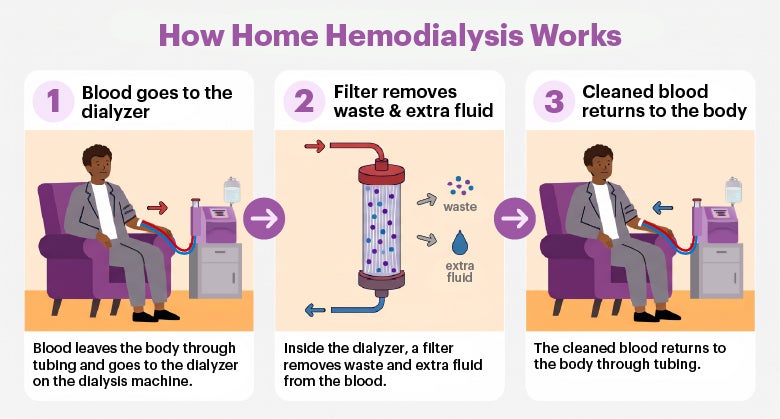
During treatment, blood moves through tubing from your body into a filter called a dialyzer (dYE-uh-lye-zer). The filter removes waste and extra fluid. The cleaned blood then returns to your body. A dialysis machine controls blood flow and helps monitor the treatment.
To connect to the machine, you need a vascular access, a place where blood can safely leave and return to your body. This may be a fistula, graft, or catheter. A fistula or graft usually requires needles for each treatment, while a catheter connects directly to the dialysis tubing. Your dialysis team will help determine which type of access is safest for you and teach you how to care for it.
Before you begin treatment at home, your dialysis team will train you to prepare the machine, connect and disconnect safely, check your blood pressure, recognize problems, keep records, and know when to call for help. You will also practice these steps with your dialysis team to make sure you can perform treatments safely at home. Training often takes several weeks and varies by program and individual needs.
Types
Standard home hemodialysis
Treatments are usually done about three times a week, often for three to five hours per session. Your treatment schedule may differ based on your health needs.
Short daily home hemodialysis
Treatments are usually done five to six days a week, often for two to four hours each time. More frequent treatments may mean less fluid needs to be removed during each session.
Nocturnal home hemodialysis
Treatments are done overnight while you sleep, often for six to eight hours per session, several nights each week. Your dialysis team will determine your schedule and explain the monitoring and safety measures needed.
Your dialysis schedule is personalized. Do not change how often or how long you dialyze without talking with your dialysis team.
Effectiveness
Home hemodialysis can remove waste and extra fluid effectively. More frequent or longer treatments may help some people manage fluid, blood pressure, and symptoms, but results vary. Your dialysis team will review your blood tests, symptoms, weight, blood pressure, and how well your treatments remove waste and extra fluid to make sure you are getting enough dialysis.
Safety
Possible problems with home hemodialysis include low blood pressure, muscle cramps, bleeding, infection, and problems with your vascular access or equipment. Serious blood loss can occur if a needle or bloodline becomes disconnected. Your dialysis team will teach you how to recognize warning signs, respond to emergencies, and use your equipment safely.
Contact your dialysis team right away if you notice redness, swelling, drainage, or other signs of infection around your vascular access, have a fever, experience repeated machine alarms, or have difficulty completing a treatment.
Call 911 for serious bleeding, chest pain, trouble breathing, fainting, or another medical emergency. Follow your dialysis team's emergency instructions while waiting for help.
Power outages or equipment problems can interrupt treatment. Your dialysis team will help you create an emergency plan, including what to do if your equipment stops working, whom to contact for help, and how to receive dialysis if you cannot complete treatment at home.
Learn more about preparing for home dialysis and planning for unexpected situations.
Additional considerations
Your home and supplies
You will need a clean treatment area, room for supplies, and possibly changes to electricity or plumbing, depending on your equipment. Ask your home dialysis program to review your space and explain deliveries, storage, and equipment support.
Care partners and training
Some programs require a care partner, while others may offer options for people who can perform treatment independently. Ask your program what support is required. Your care partner, if you have one, should receive appropriate training.
Work, travel, food, and fluids
Home treatment may make scheduling work, school, and travel easier. You will still need a plan for equipment and supplies when traveling. Your eating and fluid recommendations depend on your dialysis prescription, blood tests, and other health needs.
Costs and insurance
Medicare and other insurance plans may cover home dialysis and training, but coverage and out-of-pocket costs vary. Ask your dialysis social worker about equipment, supplies, home modifications, and care partner costs before starting.
You do not have to manage home dialysis alone. Your training team remains available for questions, monitoring, and safety support.
Questions for your healthcare team
- Is home hemodialysis a good choice for my health and daily routine?
- Which treatment schedule and vascular access would you recommend?
- How long will training take, and do I need a care partner?
- What equipment, storage space, or home changes will I need?
- What should I do if the machine alarms or I have a medical emergency?
- How will we know whether I am getting enough dialysis?
- What will insurance cover, and what might I need to pay?
Kidney Health Resources
Explore more information and resources about kidney health.
- Explore the Home Dialysis Hub
- Preparing for home dialysis
- Choosing dialysis: Which type is right for me?
- Peritoneal dialysis
- Home dialysis: What you need to know
NKF Information and Support
Connect with NKF for answers, support, and free learning programs.
Healthcare professional resources
Explore education, clinical tools, and practical resources to support kidney care and help you stay current in your practice.