February 05, 2025

The 1960s were a turning point for kidney disease. Discover how dialysis, transplants, and NKF’s advocacy laid the foundation for today’s kidney care.
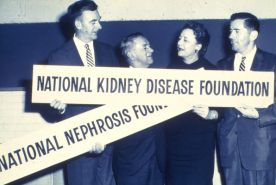
Former First Lady Mamie Eisenhower with Dr. George E. Schreiner at the NKF's Annual Meeting in 1968.
Picture the 1960s. Do images of hippies, the moon landing, and civil rights marches come to mind? The '60s were a time of cultural revolution, scientific breakthroughs, and social change.
You may not know that this time also marked a turning point in kidney care.
This decade laid the groundwork for the care that millions of people receive today. The National Kidney Foundation (NKF) was there to educate the public, push for better care, and advocate for life-saving treatments.
Here's a closer look at the kidney disease milestones and NKF achievements of the 1960s.
Kidney Disease Treatment Innovations
- 1960: Researchers added Teflon to dialysis machines to stop blood clotting. Blood clots were a big problem in early dialysis. Teflon fixed this by creating a smooth, non-stick surface. It is still used in dialysis machines today.
- 1960: Dr. Belding Hibbard Scribner invented the Scribner shunt. Before this invention, people had surgery each time they needed dialysis. The shunt allowed repeated access to a patient's bloodstream. It enabled people with kidney failure to receive dialysis for much longer. Learn more about dialysis access.
- 1961: Dr. Kountz performed the first successful kidney transplant between non-identical twins. He proved transplants could work even when donors and recipients aren't perfect matches.
- 1962: The first outpatient hemodialysis center in the U.S. opened in Seattle. This center allowed people to get dialysis without staying in the hospital.
- 1967: Dr. Kountz helped create the Belzer kidney perfusion machine. This machine kept donated kidneys healthy for about 28 hours.
Your gift today can help kidney patients live.
- Equip patients and families with knowledge, resources, and access to high-quality care
- Advocate for policies that address disparities and prioritize kidney health for all
- Fund research and technology to advance early detection, improve treatment, and expand transplant access