August 26, 2026
Article By: NKF Staff

You may have heard the phrase, “Kidney disease runs in the family.” But what does that really mean?
The terms genetics and family history are often used as if they mean the same thing. While they are connected, they describe different things.
Understanding the difference between the two can help you better understand your kidney health and talk with your healthcare professional about your risk.
Key Takeaways
Key Takeaways
Genetics
- Refers to the genes inherited from parents.
- Some gene changes can directly cause inherited kidney diseases.
- Other gene changes can increase the risk of developing kidney disease.
Family History
- Refers to health conditions that affect relatives.
- May suggest a higher risk, but does not mean someone will develop kidney disease.
- Learned by talking with family members.
What Are Genetics or Genes?
Genes act as the body’s instruction manual, telling it how to develop and function.
Everyone inherits a set of genes from each of their biological parents.
Sometimes, a gene contains a change called a genetic variant. Some genetic variants are harmless, like eye color. Others may increase the risk of developing certain diseases, like chronic kidney disease (CKD).
Examples of inherited kidney diseases include:
“My mom and grandmother both had PKD, a genetic condition that causes fluid-filled cysts to grow on the kidneys,” Daniel Kushnik, a transplant recipient, said. “I knew my risk of inheriting it was high. And I did, unfortunately."
Other gene changes, like certain variants of the APOL1 gene, may not cause kidney disease on their own but make someone more likely to develop kidney problems when combined with other risk factors.
“I learned my kidney disease was likely influenced by an APOL1 genetic variant. I never had diabetes, high blood pressure, or other risk factors,” transplant recipient Shanaha Brown said. “This is likely the closest answer as to what caused my kidney disease."
Most genetic variants related to kidney disease, whether known to physicians or as yet undiscovered, raise or lower the risk of kidney disease but have far from 100% certainty for the disease.
It’s important to remember that while people may inherit one of these conditions, others can develop kidney disease for reasons unrelated to genetics.
What is Family History?
Family history means that one or more of your relatives has kidney disease or another health condition.
A family history can reflect shared genes, shared habits, and environments, or both.
For example, families share certain genes, but they may also share diet and lifestyle factors that increase risk. It’s important to remember that some factors, like access to healthy foods or education, exist outside one’s individual control.
Family history may include:
- A close relative, such as a parent, brother, sister, or child, with kidney disease.
- Family members with conditions that increase the risk of chronic kidney disease (CKD), like diabetes or high blood pressure.
- Multiple relatives with kidney disease, including more distant family members like grandparents, aunts, uncles, or cousins. This can sometimes suggest an inherited form of kidney disease.
"My family has a history of high blood pressure, but I didn’t want to go to the doctor and learn anything bad," Larry Gayao, known as Larry g(EE) on stage, said. "I share my story now because I want my nieces and nephews to know that they can take charge of their health now and hopefully avoid kidney failure in the future.”
Having a family history does not mean someone will definitely develop kidney disease. It means their risk may be higher than someone without that family history. It also provides important clues for diagnosing kidney disease or identifying inherited kidney conditions.
Take our one-minute quiz to learn if you’re at risk of developing kidney disease.
When Should Someone Consider Genetic Testing?
Genetic testing is not necessary for everyone.
A healthcare professional may recommend genetic testing if someone:
- Has kidney disease that began at a young age or without a clear cause.
- Has a large family history of kidney disease or a relative with a known inherited kidney condition.
- Has signs or symptoms linked to a genetic kidney disease, like kidney cysts.
If you are interested in genetic testing, talk with your healthcare professional. They can help determine whether testing is appropriate and may refer you to a genetic counselor or kidney specialist for additional guidance.
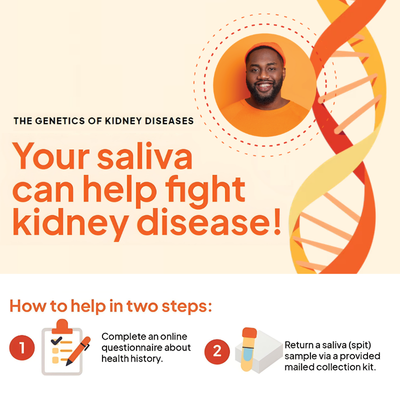
Help Researchers Better Understand the Genetics of Kidney Disease
Rutgers researchers are working to learn more about how genetic differences may influence kidney disease. By joining a large-scale kidney genetics study, you can help uncover new information that may lead to improved ways to diagnose and treat kidney disease in the future.
This study is looking for people with and without kidney disease. Participation is completed from home, and eligible participants will also receive free ancestry results as part of their participation. This is a research study and not a genetic test.