Last updated: October 29, 2026
Medically reviewed by: NKF Patient Education Team
Learn about the new Nutrition Facts Label to manage your kidney diet. Check serving sizes, calories, fat, sodium, carbs, protein, potassium, and phosphorus.
Table of Contents
- About the Nutrition Facts Label
- Start with serving size and servings per container
- Understand calories and % Daily Value
- Check nutrients that matter for kidney health
- Read the ingredient list
- Use the Kidney-Friendly Food Mark when shopping
- Put it all together when choosing a food
- Talk with a kidney dietitian
- Kidney health information, support, and professional resources
About the Nutrition Facts Label
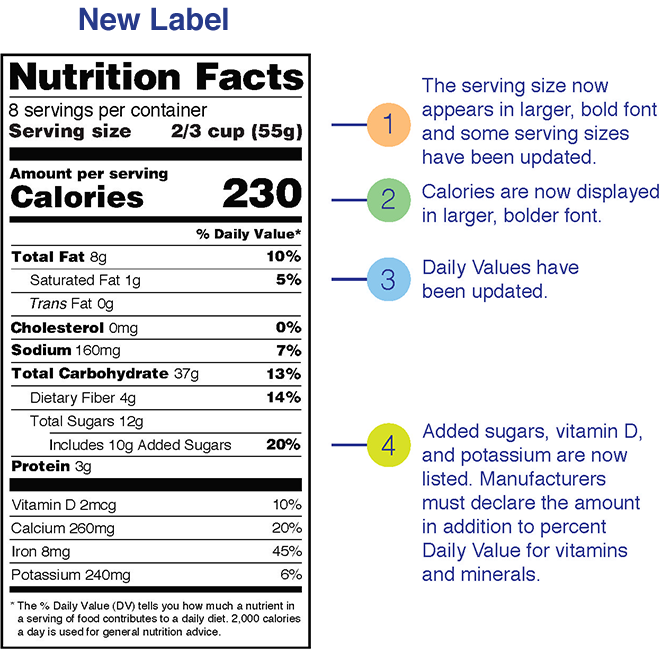
The Nutrition Facts Label helps you understand what is in packaged food and drinks. It shows the serving size, calories, and amounts of key nutrients. You can use the label to compare foods and choose options that support your kidney health.
You do not need kidney disease to benefit from reading food labels. If you have chronic kidney disease (CKD), your doctor or kidney dietitian may ask you to pay closer attention to certain nutrients. Your needs depend on your kidney function, lab results, other health conditions, and whether you receive dialysis.
Start with serving size and servings per container
Serving size tells you the amount of food used to calculate the nutrition information. It is not a recommendation for how much you should eat. Servings per container tells you how many servings are in the package.
All the numbers on the label usually apply to one serving. If you eat more or less, the amounts change.
| If the label says | What you actually eat |
|---|---|
| Serving size: 1 cup; sodium: 300 mg | 1 cup = 300 mg sodium |
| 2 servings (2 cups) | 2 cups = 600 mg sodium |
| ½ serving (½ cup) | ½ cup = 150 mg sodium |
Your own portion may be different from the serving size on the package. Ask your kidney dietitian what portions work for you.
Understand calories and % Daily Value
Calories
Calories show how much energy is in one serving. Your body needs energy each day. Some people need more calories, while others need fewer. Your kidney dietitian can help you choose an amount that meets your needs.
Percent Daily Value (%DV)
The % Daily Value shows how much a nutrient in one serving contributes to a general daily diet. As a quick guide, 5% DV or less is low and 20% DV or more is high.
The %DV is based on general nutrition needs, not your personal kidney eating plan. For nutrients such as sodium, potassium, and protein, follow the goals your healthcare team gives you.
Check nutrients that matter for kidney health
These are important parts of the Nutrition Facts Label. You may not need to limit all of them. Focus on the nutrients your kidney dietitian has recommended for you.
Sodium
Sodium is found in salt and many packaged foods. Too much sodium can raise blood pressure and cause your body to hold on to extra fluid. Compare the milligrams (mg) of sodium per serving in similar foods, and choose lower sodium options when possible.
As a general label-reading guide, 5% DV or less of sodium is low and 20% DV or more is high. Some people with CKD are advised to aim for less than 2,300 mg per day, but your goal may be different. Ask your healthcare team about your sodium goal.
A product labeled “reduced sodium” may still have a lot of sodium. Always check the amount per serving. Some salt substitutes and lower sodium products contain potassium chloride, which may matter if you need to manage potassium.
Potassium
Potassium helps your muscles and nerves work. Some people with CKD need to limit potassium, while others do not. Your blood test results and medicines help your healthcare team decide what is right for you.
The label lists potassium in milligrams (mg) and as a %DV. If you need to manage potassium, compare the amount per serving and check ingredients for potassium additives, including potassium chloride. There is no single potassium limit that applies to everyone with CKD.
Phosphorus
Phosphorus helps keep bones and cells healthy. If phosphorus builds up in your blood, it can harm your bones and blood vessels. Not everyone with CKD needs the same amount of phosphorus.
Phosphorus does not have to appear on the Nutrition Facts Label. Check the ingredient list for added phosphates, such as phosphoric acid, sodium phosphate, or calcium phosphate. A useful clue is an ingredient containing “phos.” Phosphate additives are generally absorbed more easily than phosphorus found naturally in food.
Talk with your kidney dietitian before cutting out nutritious foods solely because they contain phosphorus.
Protein
Protein helps your body build and repair muscles and other tissues. The label shows grams (g) of protein per serving. Protein needs vary. People with CKD who are not on dialysis may need a different amount from people receiving dialysis.
Use the grams on the label to help meet your personal daily protein goal. Seven grams of protein on a label does not mean the food itself weighs one ounce. Ask your kidney dietitian how much protein you need.
Total carbohydrate, fiber, and added sugars
Total carbohydrate includes starch, sugar, and fiber. It may be especially important to track if you have diabetes. Your carbohydrate goal depends on your meals, medicines, activity, and blood sugar plan.
Dietary fiber supports digestion. Choose fiber-rich foods that fit your kidney eating plan. Check “Added Sugars” to compare products and choose foods with less added sugar when possible. “Sugar free” does not always mean carbohydrate free.
Total fat and saturated fat
The label lists total fat and saturated fat. Choosing foods lower in saturated fat can support heart health. Unsaturated fats, such as those in olive oil, can be part of a healthy eating pattern. The best choices depend on your calorie and nutrition needs.
Calcium and vitamin D
The label includes calcium and vitamin D. These nutrients support bone health, but people with CKD may need special guidance about foods or supplements containing them. Do not start calcium or vitamin D supplements without discussing them with your healthcare team.
Read the ingredient list
Ingredients are listed from the greatest amount by weight to the smallest. The ingredient list gives you information that may not appear in the Nutrition Facts Label.
Look for phosphate additives with “phos” in the name, sodium-containing ingredients, and potassium chloride if you have been told to manage potassium. A long ingredient list does not automatically mean a food is unhealthy. Look at the whole food, its serving size, and your personal needs.
Put it all together when choosing a food
For each packaged food or drink, use these simple steps:
- Check the serving size and decide how much you plan to eat.
- Look at sodium and any other nutrients your care team wants you to manage.
- Read the ingredient list for phosphate additives and, if needed, potassium chloride.
- Compare similar products. Check both the amount per serving and the portion you will eat.
- Use The Mark as an extra guide, not as a replacement for your eating plan.
No single food has to provide everything you need. A variety of foods and portions that work for you can help you eat well.

Kidney health information, support, and professional resources
Learn more about kidney health
Explore more information and resources about kidney health.
More education and information from NKF
Connect with NKF for answers, support, and free learning programs.
Resources for healthcare professionals
Explore education, clinical tools, and practical resources to support kidney care and help you stay current in your practice.