Last updated: June 30, 2026
Medically reviewed by: NKF Patient Education Team
Learn about FSGS, a kidney disease causing scarring in glomeruli.
About FSGS
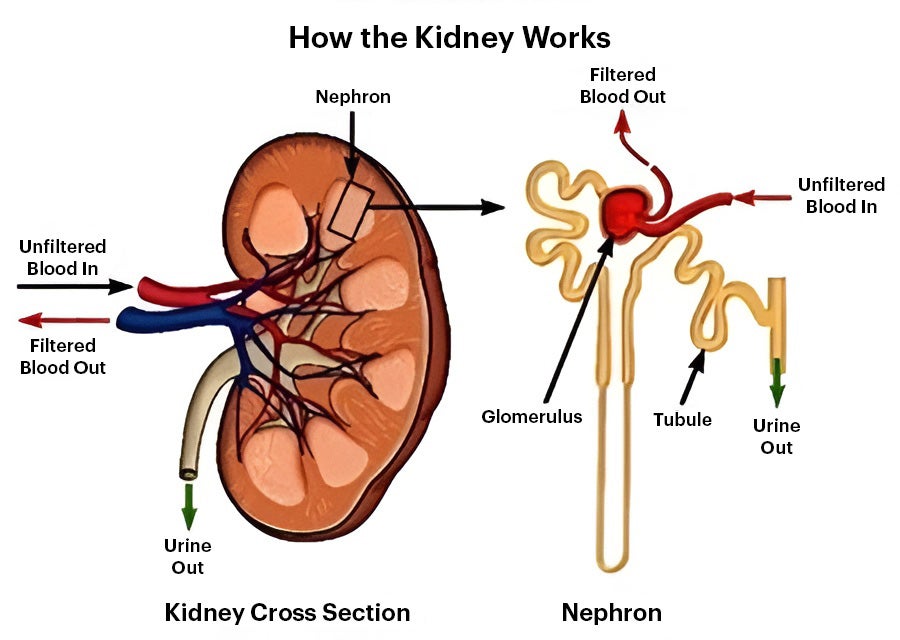
FSGS (focal segmental glomerulosclerosis) is a type of glomerular disease that involves scarring (sclerosis) in your kidney. The scarring of FSGS only takes place in small sections of the glomeruli. Glomeruli are tiny filtering units in the kidney that filter, or clean, your blood to get rid of toxins and make urine. Damaged glomeruli can lead to kidney disease.
Signs and Symptoms
Early stages may not cause any symptoms. You may only see some signs on your own, while others may be found by your healthcare professional. Signs and symptoms of FSGS can include:
- Swelling in body parts like your legs, ankles and around your eyes (edema)
- Weight gain due to extra fluid building in your body
- Foamy urine caused by high protein levels in the urine (proteinuria)
- High fat levels in the blood (high cholesterol)
- Low levels of protein in the blood (hypoalbuminemia)
Causes
FSGS is not caused by a single disease. It can have many different causes. The scarring may happen because of an infection, drug, or disease that affects the entire body, like diabetes, HIV infection, sickle cell disease or lupus. Certain genes have also been linked to a higher risk for FSGS. FSGS can also be caused by another glomerular disease that you had before you got FSGS.
Types
FSGS has different types based on the cause. Types of FSGS include:
- Primary (idiopathic) FSGS: This type of FSGS means that the disease happened on its own without a known or obvious cause. It can be triggered by an issue with the immune system that directly attacks the kidney's filtering units (glomeruli).
- Secondary FSGS: This type is caused by another disease or a drug. Examples include viruses such as HIV or drugs such as anabolic steroids that some people use to speed up their muscle growth (these are different than steroids your doctor gives you for treatment).
- Genetic FSGS: Also known as familial FSGS, this form is caused by gene risk variants (such as changes in the APOL1 gene) and can appear in multiple family members.
Diagnosis
A diagnosis can involve an observation of any symptoms, blood and urine tests, and a kidney biopsy.
A urinalysis is a test that checks your urine for general signs of health issues.
An eGFR, or estimated glomerular filtration rate, is a blood test that shows how well your kidneys are filtering, or removing, wastes form your blood.
A urinary albumin-creatinine ratio (UACR) is a urine test that checks for high protein (albumin) in the urine, which is a sign of kidney damage.
A urine protein-to-creatinine ratio (UPCR) may also be used. This test is similar to the UACR test, which measures albumin. Instead of measuring only the amount of albumin in your urine, it measures all the different proteins that may be present.
A kidney biopsy is usually needed to confirm a FSGS diagnosis. A kidney biopsy is a test that involves a procedure where a tiny piece of your kidney is removed with a special needle, and looked at under special microscopes.
Treatment
Treatment for FSGS includes managing blood pressure, proteinuria, and cholesterol with medications, and lifestyle changes.
Medications
Medications used to slow the process of kidney damage from FSGS may include the following.
Corticosteroids and immunosuppressive medicines are used to calm your immune system and stop it from attacking the filtering units in the kidney (glomeruli).
ACE inhibitors and ARBs are blood pressure medications used to reduce protein loss and control blood pressure.
Diuretics (water pills) are medications that help your body get rid of excess fluid and swelling. These can be used to lower your blood pressure too.
SGLT2 inhibitors were originally developed for type 2 diabetes to manage blood glucose (sugar) levels. Studies also showed benefits in kidney and heart health for people with CKD and/or heart failure, with or without diabetes. The benefits are highest in people who also have protein in their urine (albuminuria/proteinuria).
A cholesterol medicine, such as a statin, can be prescribed to help protect your heart.
In April 2026, The FDA approved Filspari (sparsentan) for the treatment of FSGS. The drug works by blocking endothelin receptor [type A] (ERA) and angiotensin receptor II type 1, both of which can have a role in FSGS. The drug was already approved to treat IgA nephropathy (IgAN). Sparsentan happens to be BOTH an ERA and an ARB, so should not be used in combination with an ACE inhibitor or ARB.
Other medicines are being studied in clinical trials. Discuss available treatments or clinical trials with a healthcare professional to find out which may be best for you.
Nutrition
Practicing a healthy lifestyle and getting regular exercise should also be part of the treatment plan. You may need to limit your sodium, or salt intake, especially if you have high blood pressure. You may also be asked to change your diet in other ways, such as lowering cholesterol and saturated fats. A kidney dietitian can help with a meal plan that’s right for you.
Future Health
You should talk with a healthcare professional about your condition because the progression of the disease depends on many factors. FSGS is a chronic disease because the scarred glomeruli cannot be repaired. Treatment can slow the process of kidney disease. Everyone is different in how they respond to treatment. Over time, some patients with FSGS gradually get worse until they reach kidney failure. If this occurs, they will need a kidney transplant or dialysis to stay alive. Some people respond well to treatment and may live with the disease for many years while being monitored for any signs of change.
Preparing for your appointment
Questions to ask
- Am I at risk for FSGS?
- Do I need to get tested for FSGS?
- What was my most recent uPCR or uACR result? If my last result was not at goal, what can I do to make it lower?
- What is my risk of developing kidney failure because of my FSGS?
- What lifestyle changes do you suggest I make to help prevent complications?
- Are there any changes I need to make with my diet? Can you refer me to a dietitian to help me?
- Do I have to make any changes with my medications?
- What symptoms should I watch for that might indicate my condition is worsening?
- What warning signs should prompt me to seek immediate medical attention?
- Is a clinical trial something I should consider?